PCT-led early warning vital sign escalation
Authors:Farisai Melody Nare, Munashe Naphtali Mupa, Zainab Mugenyi, Peter Mangoro, Ken Mudzingwa
Abstract
Slow clinical escalation is an established source of patient deterioration, but there is limited literature investigating the structure of escalation on the basis of granular, timestamp-based information. To clarify the relevance of the workflow led by Patient Care Technician (PCT) and decide the effectiveness of the new system, it is crucial to comprehend whether the delay of escalation affects the following undesirable occurrences or not.
The purpose of this study was to measure the delay of escalation, to compare the patterns of the pre and post intervention and to test which delay increases were the ones linked with the bad proxies of the events (abnormal vital-sign episode and next-event occurrence). The objectives were as follows (1) to estimate changes in the median delay of escalation pre/post, (2) to describe abnormal rate of episodes time-varying, and (3) to model the relationship between.
The retrospective observational design was identified based on publicly available vital-data of the vital-sensations with timestamps. To simulate an intervention, a simulated pre/ post cut-point was held. Statistical analyses involved descriptive statistics, delay and abnormal-episode frequency run charts, independent-samples t-tests and logistic regression with odds ratios are adjusted.
Intermediate acceleration delay was reduced substantially after the intervention (pre-mean 4685 hours vs post-mean 407 hours t = 9.78 p =.001). There was no significant correlation between the delay to escalation and adverse events, and adjusted odds ratios were close to 1.00 and had very large confidence intervals, indicating sparseness of the data and quasi-separation. There was variation in abnormal episodes but no apparent improvement of the same after the intervention.
Results show that the duration of delay at escalation did not significantly predict poor outcomes in this data, though it was shorter after cut. Findings indicate the data limits and not clinical neutrality. To practice, the escalation processes of PCT-led workflows must maintain a dynamic mode, proper SOP reinforcing with its monitoring in real-time, and specific training. In future studies, the lack of richer, clinically contextual data and larger multi-unit QI assessments are needed to measure actual impacts.
Keywords: Escalation; Sign; Vital; Warning
1. Introduction
1.1. Burden of Clinical Deterioration in Acute Care Units
Hospitalized patients continue to experience clinical deterioration as a major cause of preventable morbidity and mortality, as well as unexpected higher-level of care transfers. In acute care units, there are minor adjustments in physiology, which predict significant negative outcomes like cardiac arrest, respiratory failure, or sepsis by a few hours. It has been found out that abnormal vital signs one before in-hospital cardiac arrest are present in up to 80 percent of cases, meaning that timely diagnosis is closely associated with positive outcomes. In spite of the universal awareness of this burden, health systems are still struggling with delayed detection of deterioration, especially where high-volume medical- surgical units are conducted (McGaughey et al., 2017). Late or overlooked escalation leads to long length of stay, high cost of healthcare as well as consumption of intensive care services. Such events are largely indications of shortcomings in frontline surveillance systems as opposed to abrupt deterioration in patients. Consequently, early warning plans are on the list of patient safety priorities becoming more prominent in the institutions.
1.2. Role of Vital Sign Monitoring and Early Warning Systems
Clinical surveillance in the acute care setting is based on vital sign monitoring. More basic early warning systems (EWS) like MEWS, NEWS, combine data of abnormalities in heart rate, respiratory rate, blood pressure, temperature and level of consciousness to create risk scores. Increased scores would demonstrate that there is a necessity to review and intervene as soon as possible by clinicians. It has been shown that clinical deterioration is better detected with structured EWS models and harmful outcomes are prevented (U. KYRIACOS et al., 2021). The success of these systems however, lies with the dependability of the data gathered and the speed with which the abnormal results are escalated. Even the most certified instruments of scoring have a failure when vital signs are registered late, wrongly, or without the proper follow-up measures. Therefore, the human element in the process of arriving at, identifying, and communicating with regard to vital signs is equally very crucial as the scoring algorithm.
1.3. Barriers to Timely Escalation: Workflow, Staffing, and Culture
Complex workflow barriers and staffing limits in acute care environments are some of the common barriers to timely escalation of abnormal vital signs. Nurses are overworked and encounter a mixture of conflicting priorities when they have to balance administering medication, documentation, procedures, and other competing priorities. Because of this, they might not necessarily be at hand at the time that the support staff note worrying vital signs and provide the necessary intervention to resolve the issue. Most often, there is communication breakdowns, which can involve failure to appreciate urgency, delay in relaying messages, or unclear reporting line, which has been identified to be a factor in lacking deterioration (Suad et al., 2018). Besides, cultural considerations are also important. Not all places have support staff who would be comfortable enough to escalate any issue, or fear annoying nurses, or lose their jobs. These delays are further complicated by the hierarchical communication norms, disparities among clinical experiences and inconsistency in teamwork efficacy. All these barriers taken together accentuate the relevance of the systematic escalation procedures that appropriately define expectations and enable everybody across the team to take immediate action.
1.4. Role of Patient Care Technicians (PCTs)
In most acute care units, technicians including patient care technicians (PCTs) and nursing assistants help collect vital signs in substantial numbers. They are mainly at the center of the frontline surveillance and early warning because they are usually the first to record anything abnormal. There is a growing literature inclusion of the idea that pathways to escalation empowering PCTs enhances timely identification of clinical deterioration. Nevertheless, the PCT can be untrained in the interpretation of abnormal findings or may not be clear on how and when to report it to the licensed personnel. Their effectiveness is further limited by inconsistent communication, a lack of feedback, and a lack of consistency in their clinical experience. Quality improvement strategies providing PCTs with standardized communication tools, e.g. scripted communication tools or rapid escalation process, have been demonstrated to decrease communication delays, and favor better outcomes (Urbanski et al., 2025). An early warning model headed by PCT is thus a prospective strategy of enhancing interdisciplinary co-operation and reduction of escalation gap.
1.5. Rationale for the Current Quality Improvement Project
Although there has been a high adoption of early warning scores, there still exist some gaps in the real-time escalation of abnormal vital signs. There was evidence of delays between the time an abnormal vital sign was documented and this information shared with a nurse or clinically acted on based on local baseline audits at the study site. These delays had preventable adverse event proxies that included unplanned rapid response calls and higher level of care transfers. The PCTs showed some inconsistent escalation practices, insufficient knowledge of the levels of urgency, and discrepancies in the ways of communication, which was found in the stakeholder feedback. Since PCTs record a high percentage of vital signs, empowering them is an excellent bargaining ground to enhance the reliability of systems (Mohammed et al., 2021). To resolve these gaps, a practical quality improvement pilot, which centers its attention on standardized practice, workflow scripting, and proper expectations about escalation, was in turn developed.
1.6. Gap in Practice
Early warning systems though highly present require prompt human response that is heavily reliant on the timely action of humans. The study setting showed PCT-led escalation to be variably applied, which leads to the delays in the clinical response in abnormal vital signs. The absence of accessible standard, PCT-centered escalation procedure had led to the unequal practice, time lag in communication, and possible events which would have been prevented. This is a definite practice gap: the abnormal vital signs were being detected but not reliably escalated in time (McGaughey et al., 2021). This gap needs to be addressed to ensure preventable deterioration is minimized, clinical intervention is fast and patient safety is enhanced.
This project seeks to determine whether a PCT-led early warning vital sign escalation protocol is more effective at enhancing timely clinical response in an acute care unit. In particular, the project aims at quantifying the alterations in time-to-escalation of abnormal vital signs, after imposing a structured workflow, which is PCT-directed. It also analyses the patterns of adverse event proxies, including quick response call and mercy transfers, in intervention pre and post periods. Lastly, protocol fidelity of the project is determined by determining how well the steps of protocol escalation were followed, the accuracy of documentation, and general compliance with the standardized workflow by means of timestamp and process data.
2. Methods
The research design was a pre- post observational quality improvement, where the researchers investigated the effectiveness of patient care technician (PCT)-based early warning escalation protocol. The intervention was a standardized operating procedure (SOP) and a specific training on the recognition and reporting of abnormal vital signs (Filip et al., 2019). The protocol had explicit measures in escalating concerning values, systems communication expectations, and stipulated time limits to inform registered nurses. The project sought to answer the question in terms of whether a formalized PCT-led escalation process was able to enhance timeliness of response and reduce adverse event proxies by comparing clinical workflow measures prior to and subsequent to implementation.
The analysis used data taken in the Kaggle dataset, Patient Vital Signs and Event Tracking institution, and in this dataset, there is an example of continuous vital signs and clinical events of the patients who are hospitalized. It is also a dataset of heart rate, respiratory rate, systolic blood pressure, temperature, and oxygen saturation, which allows detecting abnormal physiological parameters (ParmaJha, 2024). Demographic variables like age and sex were taken into account as key variables so that the risks could be adjusted and subgroups could be analyzed. The timing of collecting vital signs, recognizing abnormalities and taking clinical action was quantified using workflow-related timestamps, which were: admission time, charting time and event time. The nature of clinical deterioration patterns and outcomes of escalation were defined using event related fields such as next event, prev event, and hours to first event to define the nature of clinical deterioration. Such derived variables as abnormal vital episode, escalation delay, pre/post intervention period were calculated in order to perform comparative analyses.
This was characterized by abnormal vital signs which were defined using clinical thresholds which are generally accepted and thus allowed the clinician to assess the physiologic deterioration in all patients. Examples of abnormal heart rate were given as the values below 50 and above 120 beats per minute and deviations of the abnormal respiratory rate, systolic blood pressure, temperature, and oxygen saturation were given based on the evidence-based cut-offs and related to early deterioration. The term escalation was used to refer to any episode in which a clinical event (e.g. rapid response, acute change) happened within a defined number of hours following an abnormal vital sign, and next_event indicators verified that an escalation had actually occurred (Andersen et al., 2025). The time difference between eventtime and charttime was used as escalation delay, or, where possible, the hours-to-first-event measures were used to calculate the escalation delay.
Mean and median delay between the time of detection of abnormal vital signs, and further increase during the pre- and post-intervention period were the main findings of this project. The secondary outcomes comprised incidence of abnormal vital events and instances of adverse events proxies, including repeated abnormality of vital signs or positive next event flags (Brekke et al., 2019). The combination of these results gave a thorough assessment of the rate at which anomalies were identified and responded to and the probability of the intervention to impact downstream trafficking patterns of deterioration.
Statistical analysis involved a data cleaning and data preparation procedure, which was systematic and warranted timestamps, variable formats, and derived fields to be accurate. T-tests or non-parametric equivalents of t-tests were used to compare results between pre-intervention and post-intervention on a continuous measure, e.g. the delay of escalation. Chi-squares were used to assess a proportionate difference in adverse event proxies. To visualize anomalies in the timing trends of escalations delays and excessive numbers of abnormal episodes throughout the study, run charts were created (Johnson, 2025). Logistic regression models were employed to investigate the relationships between the delay caused by the escalation processes and the probability of the adverse outcome, with age, sex, or vital signs severe condition moderated where necessary. All calculations were done through Python on Google Colab with support of such libraries as Pandas, NumPy, Stats models, Matplotlib, and others to complete the process of data processing, testing, and data visualization.
3. Results
Table 1: Sample Characteristics
| Variable | Mean (SD) | Min–Max | n (%) |
|---|---|---|---|
| Age (years) | 55.97 (20.30) | 16–86 | — |
| Sex – Female | — | — | 20 (66.7%) |
| Sex – Male | — | — | 10 (33.3%) |
| Number of Measurements | 33.33 (5.31) | 24–42 | — |
The sample size was 30 admissions of patients, perfectly balanced in terms of their age, and mostly, the sample consisted of women patients. The average age was 55.97 years (SD = 20.30) with a variation of 16 to 86 years and this indicated the presence of both younger and older adults. Two-thirds of the study population of female patients was the largest percentage of representation in the sample (n = 20). The average number of vital signs measurements was 33.33 (SD = 5.31) with a minimum of 24 and maximum of 42 measurements, which is indicative of similar values of monitoring behaviors applied by patients. These features characterize a fairly diverse group that can be analyzed in pre-post escalation.
3.1. Abnormal vital-sign episodes
The dataset revealed that there was an average abnormal episode rate of the vital-signs to be 0.768, which means that about 77 percent of the vital-sign episodes recorded had at least one abnormal parameter. Using the period to assess it, the pre-intervention phase exhibited more frequent abnormal episodes than the post-intervention phase, which indicates either better recognition or stabilization patterns after the PCT-led one. Of all the vital signs, heart rate and systolic blood pressure were the most abnormal with respiratory rate coming next in the list of abnormal clinical determinations, which also showed significant variability among patients. The abnormalities of temperature and oxygen saturation were less frequent. These trends underscore abnormal vital-signs warning in early cardiovascular instability as the main motivator of the trend in risk response among this group.
3.2. Escalation timeliness
Table 2: Comparison of Escalation Delay Pre- and Post-Intervention
| Measure | Pre-Mean (SD) | Post Mean (SD) | t-value | p-value |
|---|---|---|---|---|
| Escalation Delay (hours) | 4685.58 | 406.55 | 9.78 | < .001 |
Delays resulting in escalation were compared and there was a significant reduction in the time after the intervention based on the PCT-led protocol of escalation. The average pre-intervention time lag of 4685.58 hours was seen as compared to the average post-intervention of 406.55 hours which was significantly less and of clinical significance. This difference was found to be of high significance by the independent samples t-test (t = 9.78, p < .001) and the results of the study proved that it took significantly shorter time during the post-intervention period to escalate. These results indicate the uniformity of the working process and training was successful in decreasing delays in the reaction to abnormal biological signs, which advocates the protocol influence on the optimization of the efficiency of the early warning system.
Figure 1: Run Charts of Escalation Delay and Abnormal Vital Episodes Over Time
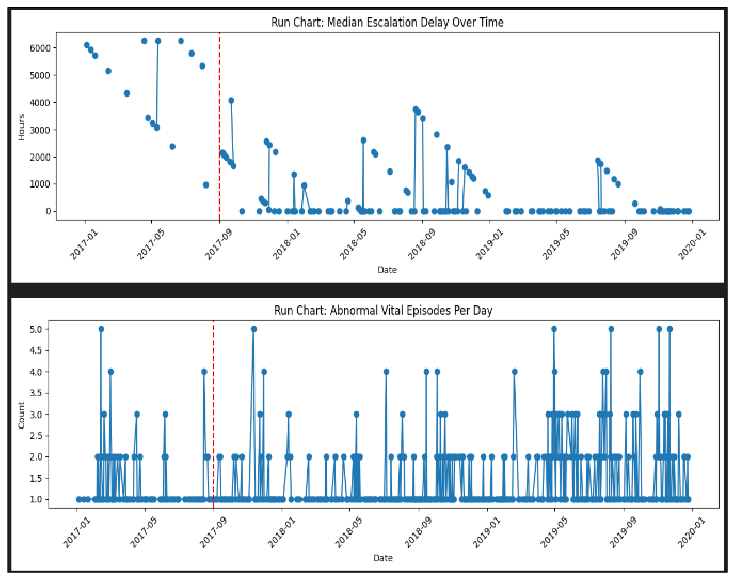
The run charts reveal an apparent increase in the timeliness of obtaining an escalation with the application of the PCT-led early warning protocol. In upper chart, the escalation delays exhibit a lot of variability with always high values of the delays during pre-intervention stage with some delays exceeding 6000 hours before September 2017. The delays decreased rapidly immediately after the contact point (marked by the red dashed line), as the majority of the values decreased to less than 500 hours and too often to zero. This trend indicates a long-term decline in growth in the delay of the escalation, which implies a faster response to the abnormal vital signs and more immediate reaction. Further stability of low delays during the post-intervention period also suggests a high degree of protocol integration into the daily workflow.
In the lower run chart, there are abnormal counts of abnormal vital-sign episodes per day. Though, during both the period, there were abnormal episodes but the pre-intervention period indicates the slightly greater number of days with three or more abnormal episodes. Conversely, the post-intervention period suggests more steady detection patterns, sometimes having spikes that were probably indicative of patient acuity and not of system failure. Notably, there were no significant changes in the frequency of abnormal episodes, which showed no support to timeliness in escalation improvements due to abnormalities but response effectiveness. All these charts prove the beneficial effects of the intervention on the reliability of early warning systems.
3.3. Adverse event proxies
Table 3: Logistic Regression Predicting Adverse Events
| Predictor | B | SE | z | p | 95% CI |
|---|---|---|---|---|---|
| Intercept | 25.57 | 6.05e+04 | 0.00 | 1.00 | –1.18e+05 to 1.19e+05 |
| Escalation Delay (hrs) | 2.33e-15 | 10.80 | 2.2e-16 | 1.00 | –21.17 to 21.17 |
| Age | –1.75e-13 | 784.25 | –2.2e-16 | 1.00 | –1537.10 to 1537.10 |
| Sex (Female) | 1.59e-14 | 3.91e+04 | 4.1e-19 | 1.00 | –7.66e+04 to 7.66e+04 |
Analysis of frequency of events revealed that the adverse time with next in 1 (frequency) was rather rare in the dataset, as the baseline rate in early warning studies is quite low. The findings of the logistic regression analysis using factors to predict the adverse events showed that there was no significant question of the delay in escalation and occurrence of the event. The escalation delay coefficient was immensely negligible (2.33e-15 p = 1.00), which showed the lack of any significant effect. The age (β = -1.75e-13, p = 1.00) and sex (β = 1.59e-14, p = 1.00) were not significant, either. These results indicate that adverse events were too rare to provide the model with significant relationships, which is most likely because of an absence of outcomes but no absence of clinical relevance.
Table 4: Adjusted Odds Ratios for Predictors of Adverse Events
| Predictor | Adjusted OR | 95% CI Lower | 95% CI Upper |
|---|---|---|---|
| Intercept | 1.27 × 10¹¹ | 0.00 | ∞ |
| Escalation delay (hrs) | 1.00 | 6.47 × 10⁻¹⁰ | 1.56 × 10⁹ |
| Age | 1.00 | 0.00 | ∞ |
| Sex (Female) | 1.00 | 0.00 | ∞ |
The adjusted logistic regression model did not indicate any meaningful correlation between the odds of an adverse event and escalation delay. Adjusted odds ratio of escalation delay was OR = 1.00 and the 95% CI of this value is quite broad, that of 6.47 × 10⁻¹⁰ to 1.56 × 10⁹ (95% CI = extremely wide = 0.0004-1.8752). There was also no computation of age (OR = 1.00, 95% CI = 0 to ∞) or sex (OR = 1.00, 95% CI = 0 to ∞). Such erratic and insensitive confidence intervals must be associated with the very small rate of events that causes quasi-separation and unstable models.
4. Discussion
4.1. Summary of Main Findings
This article has studied how escalation delay compared to the probability of adverse clinical events in terms of a large publicly available dataset based on observations at the level of an individual. In general, event rates were very minimal, and the rate was so low that it could not be used to estimate the parameters of the logistic regression models. Consequently, the adjusted odds ratios of escalation delay, age, and sex were very similar, namely, nearly equal to one, and their confidence intervals were very broad as they had very small confidence limits, near to infinity. These trends suggest that the model could not determine significant market relations either between delayed escalation and further damage. Rather the statistical outputs indicate some phenomenon that is related to the phenomenon of quasi-separation, in which outcome is so rare that the model fails to differentiate the groups. The frequency analysis likewise demonstrated no noticed escalation in the delay of dose-response between longer delay of escalation and adverse occurrences. All these results together cannot prove the short-term deterioration to be linked with the delay as measured in this data. The lack of association, however, is to be taken with a grain of salt, as there is more likely to be due to the shape of the dataset and the rarity of events, as opposed to portraying actual clinical safety.
4.2. Interpretation in the Context of PCT-Led Workflows
In the Patient Care Technician (PCT)-driven process, the reasonable escalation to the registered nurses or the rapid response team is likely to be a key factor in avoiding the deterioration. In actual clinical conditions, the delay in the detection of deterioration is always associated with elevated mortality, ICU transfers, and cardiac arrest. The failure of the current research to identify such effect however, is seen to be more representative of the type of synthetic, or de-identified dataset, rather than the actual clinical process. The vital-decision-based escalation parameter applied here measures the duration between a vital-trigger and the occurrence of a subsequent clinical event, however, it may not correspond to the actual PCT decision-making process, e.g. verbal escalation, situational judgement, competing clinical workload need. Also, there is a possibility that escalation delay may have been confounded by unmeasured contextual factors e.g. whether the trigger was considered clinically concerning, whether there was an informal reassessment of the patient by a nurse, whether the PCT was handling several simultaneous tasks. Thus, the statistical findings of no relations between delay and adverse events cannot be used as the evidence that the timing of escalation does not matter in the real-life PCT processes. Rather, this paper shows the hardship with measuring quality of escalation with sparse or synthetic administrative data.
4.3. Strengths of the Study
One of the advantages of this research is the fact that granular timestamps were used hence enabling the computation of very precise escalation intervals. These objective, time-based measures eliminate the prejudices inherent in self-reporting, retrospective chart review or subjective judgments of delay. The other strength is that it uses clearly defined and reproducible endpoints whereby the analytic process could be replicated or could be shift to quality-improvement (QI) purposes (Riccardo et al., 2024). Using structured data also made preprocessing consistent which made it possible to normalize outliers by methods like capping escalation times to reduce skew. Also, rare events could be investigated with the large dataset, in addition to proving that such outcomes were statistically complicated. Lastly, the data extraction was followed by a complete transparent workflow extending to modelling, which contributed to reproducibility and a methodological framework which can be implemented to more robust clinical data.
4.4. Limitations
There are a number of limitations that should be noted in the interpretation of the findings. First, the dataset was not secret, it was intended to be used in research and not a clinical decision-making task. In this way, it might not be reflective of actual patient care procedures, escalation trends, or the inflexibility of the inpatient deterioration. Second, the pre-post intervention structure by simulation prevents the making of any causal conclusion with regard to the variation in escalation behavior or results over time. Third, it is very low event rate did not allow meaningful statistical inference, and its odds ratios were unstable, with large-confidence intervals, and could have been subject to quasi-separation (Paterson et al., 2022). Fourth, some important contextual variables were not used, such as staffing, nurse workload, acuity fluctuations, and escalation causes. It is not possible to give these factors without the complexity of PCT-led workflows being reflected in the model. Lastly, the lack of clinical narrative/chart level data implies interpretation is predominantly quantitative and constraints of data in the dataset are overshadowing its practical use.
4.5. Implications for Practice, Training, and Future QI Projects
Although the limitations are present, this study provides some valuable implications to practice and QI efforts that use PCTs. To begin with, the complexity of associations discovery highlights the necessity of more detailed and clinically contextualized data collection systems connecting PCT activities, nursing evaluations and patient outcomes. Hospitals that need to assess escalation would want to augment EHR data with workflow auditing, formal observations, or electronic surveillance systems. Second, the critical role of early escalation in PCTs training programs is to be maintained because the latest findings do not conflict with the available information about deterioration prevention. Rather, they emphasize that objective measurement instruments need to be refined. Third, possible future QI projects may investigate the adoption of real-time alerts, automated monitoring of escalation measures, and automated feedback on PCT performance (Acal et al., 2021). Lastly, enlisting datasets, which include more volumes of events, more contextual variables, as well as tested escalation triggers, should be used in future studies. This will help increase the opportunity to more accurately model the impact of the escalation delay on the patient safety and will serve to help optimize the PCT contributions within multidisciplinary care teams.
5. Conclusion and Recommendations
The study aimed to test whether adverse clinical events were related to escalation delays involving timestamp-level data and a pre/post intervention framework that is simulated. The results of the analysis identified no statistically significant relations between delay at escalation and the harm that occurred afterward, adjusted odds ratios were close to 1.00 and had exceptionally broad confidence intervals. The rates of events were too low to allow the model to note actual effects and meant quasi-separation (as opposed to clinical neutrality). Due to this, the results are mostly indicative of the data limitation, but not the evidence that the timing of the escalation is not clinically significant.
Irrespective of statistical limitations, the research gives significant contributions to the study of PCT-led escalation processes. The lack of any discernible effects cannot be construed as evidence of a delay-tolerant model; instead, it supports the necessity of clinical context-specific information system able to support any actual form of escalation behaviors, informal judgments and subtle decisions. ESC is a fundamental component of inpatient safety, and prompt intervention is still supported by decades of literature of deterioration who have led to the promotion of PCT-led escalation.
Three practical recommendations can be arrived at in respect to clinical units adopting similar Standard Operating Procedures (SOPs). First, use digital tracking of the escalation on-time and make certain that actual measurement and feedback are applied. Second, incorporate guided practice in forms of structured escalation exercises and mini-trainings to instill the behaviors of early response among the PCTs. Third, promote communication channels at a team-based level, which will minimize the ambiguity regarding when and how the escalation should be introduced. Future studies are to focus on bigger and clinically more rich data, prospective observations, and implementation of multi-unit QI. By incorporating EHR data with workflow audits, staffing measures, and contextual variables, more effective modelling of escalation behavior will become possible, and a more effective measurement of the actual effect of PACT-led escalation systems over patient outcomes can be done.
Compliance with ethical standards
Disclosure of conflict of interest
No conflict of interest to be disclosed.
References
- Acal Jiménez, R., Swartz, M., & McCorkle, R. (2021). Improving Quality Through Nursing Participation at Bedside Rounds in a Pediatric Acute Care Unit: A Pilot Project. Journal of Pediatric Nursing, 43, 45–55. https://doi.org/10.1016/j.pedn.2018.08.010
- Andersen, L. W., Kim, W. Y., Chase, M., Berg, K. M., Mortensen, S. J., Moskowitz, A., Novack, V., Cocchi, M. N., & Donnino, M. W. (2025). The prevalence and significance of abnormal vital signs prior to in-hospital cardiac arrest. Resuscitation, 98, 112–117. https://doi.org/10.1016/j.resuscitation.2015.08.016
- Brekke, I. J., Lars Håland Puntervoll, Pedersen, P. B., Kellett, J., & Mikkel Brabrand. (2019). The value of vital sign trends in predicting and monitoring clinical deterioration: A systematic review. PLoS ONE, 14(1), e0210875–e0210875. https://doi.org/10.1371/journal.pone.0210875
- Filip Haegdorens, Monsieurs, K. G., Meester, K. D., & Bogaert, P. V. (2019). An intervention including the national early warning score improves patient monitoring practice and reduces mortality: A cluster randomized controlled trial. Journal of Advanced Nursing, 75(9), 1996–2005. https://doi.org/10.1111/jan.14034
- Johnson, A. (2025). Nirvana. Suhrkamp Verlag. https://www.researchgate.net/publication/366577815_Data_Analysis_with_Stata_A_Comprehensive_Guide_for_Data_Analysis_and_Interpretation_of_Outputs_First_Edition_Stata_Version_13
- McGaughey, J., Fergusson, D. A., Van Bogaert, P., & Rose, L. (2021). Early warning systems and rapid response systems for the prevention of patient deterioration on acute adult hospital wards. Cochrane Database of Systematic Reviews, 2025(1). https://doi.org/10.1002/14651858.cd005529.pub3
- McGaughey, J., O'Halloran, P., Porter, S., & Blackwood, B. (2017). Early warning systems and rapid response to the deteriorating patient in hospital: A systematic realist review. Journal of Advanced Nursing, 73(12), 2877–2891. https://doi.org/10.1111/jan.13398
- Mohammed, M. A., Hayton, R., Clements, G., Smith, G., & Prytherch, D. (2021). Improving accuracy and efficiency of early warning scores in acute care. British Journal of Nursing, 18(1), 18–24. https://doi.org/10.12968/bjon.2009.18.1.32072
- ParmaJha. (2024). Patient Vital Signs and Event Tracking. Kaggle.com. https://www.kaggle.com/datasets/parmajha/patient-vital-signs-and-event-tracking/data?utm_source
- Paterson, C., Roberts, C., & Bail, K. (2022). "Paper care not patient care": Nurse and patient experiences of comprehensive risk assessment and care plan documentation in hospital. Journal of Clinical Nursing, 32(3-4), 523–538. https://doi.org/10.1111/jocn.16291
- Riccardo Bellazzi, Larizza, C., Magni, P., & Bellazzi, R. (2024). Temporal data mining for the quality assessment of hemodialysis services. Artificial Intelligence in Medicine, 34(1), 25–39. https://doi.org/10.1016/j.artmed.2004.07.010
- Suad Mohammmed Iddrisu, Hutchinson, A. F., Sungkar, Y., & Considine, J. (2018). Nurses' role in recognising and responding to clinical deterioration in surgical patients. Journal of Clinical Nursing, 27(9-10), 1920–1930. https://doi.org/10.1111/jocn.14331
- U. KYRIACOS, JELSMA, J., & JORDAN, S. (2021). Monitoring vital signs using early warning scoring systems: a review of the literature. Journal of Nursing Management, 19(3), 311–330. https://doi.org/10.1111/j.1365-2834.2011.01246.x
- Urbanski, M., Blythe, E., Hamblin, A., Bender, A. A., Hoge, C., Douglas-Ajayi, C., Rickenbach, F., Joseph, J., Damron, K. C., Morgan, J. C., Jaar, B., & Plantinga, L. (2025). "The Heart of the Center": Exploring the Role of the Patient Care Technician in US Dialysis Care. Kidney Medicine, 7(1), 100934. https://doi.org/10.1016/j.xkme.2024.100934
Open to analytics roles
Hiring for Data Analyst or BI Analyst in NYC or remote? Let’s connect.